GPU acceleration has become a cornerstone of modern video encoding. It delivers speed, throughput, and efficiency that software-only pipelines simply cannot match at scale. But the cloud infrastructure market has shifted in ways that are forcing video engineers and platform operators to think more carefully about how, when, and where they lean on GPU resources.
The rise of AI workloads has dramatically increased global demand for GPU compute. The same AMD, Intel, NVIDIA and Qualcomm hardware that powers your encoding pipeline is also in high demand for training and inference workloads. That has real consequences for availability windows and pricing on cloud platforms, particularly for spot and on-demand GPU instances.
This is not a criticism of GPU vendors. MainConcept works closely with AMD, Intel, NVIDIA, and Qualcomm, and GPU-accelerated encoding remains a critical and high-value part of our technology. The point is simpler: the market is more dynamic than it used to be, and encoding infrastructure that can only run one way is infrastructure that can get caught out.
The New Reality: Availability Is Not Guaranteed
Cloud operators have always dealt with resource variability. What has changed is the frequency and magnitude of GPU pricing shifts. Depending on the region, instance type, and time of day, the cost of GPU compute can vary significantly. For organizations running high-volume encoding, those fluctuations add up quickly.
The typical response has been to overprovision, lock in reserved instances, or simply absorb the cost. None of these are great options for teams trying to run efficient, scalable encoding operations. And none of them address the underlying issue: encoding pipelines that are tightly coupled to a single compute path have no fallback.
Why Switching Has Always Been Hard
Historically, moving between hardware-accelerated encoding and software encoding was not a simple configuration change. GPU encoding via AMD, Intel, NVIDIA, or Qualcomm each use different SDKs, different API structures, and different integration patterns. Software encoding is a separate path entirely. Supporting all of them meant multiple integration cycles, more code to maintain, and more surface area for things to break.
The practical result: most teams picked one path, built around it, and stayed there. That made sense when GPU resources were predictable and pricing was stable. It makes less sense now.
EVA: One API, Full Flexibility
MainConcept Easy Video API (EVA) was designed to solve the integration complexity problem, and it turns out that solution is exactly what a more dynamic compute market requires.
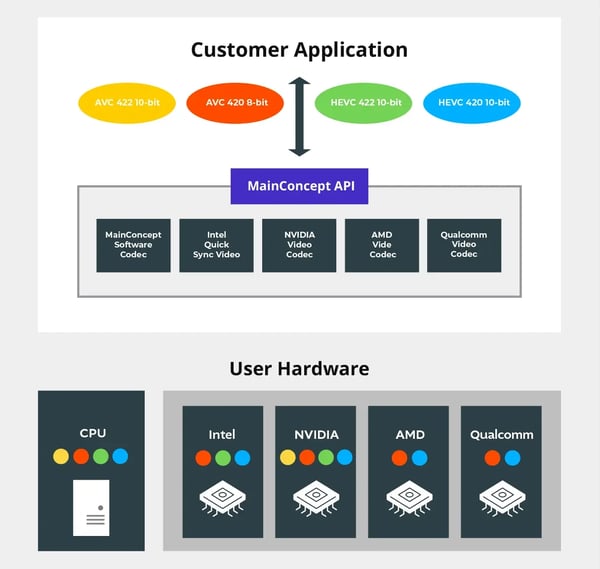
EVA provides a single unified API across MainConcept software codecs and GPU hardware codecs from AMD, Intel, NVIDIA, and Qualcomm. The supported codecs include AVC/H.264, HEVC/H.265, AV1, and JPEG XS. Instead of maintaining separate integration paths for each vendor, developers implement one pipeline and switch modes via a configuration parameter. EVA also includes hardware detection built in, so applications can query what is actually available at runtime.
That means the decision to use GPU or software encoding can be made dynamically, based on what is available and what makes economic sense at that moment. When GPU instances are readily available and priced competitively, use them. When availability is tight or pricing spikes, fall back to software encoding, without touching the integration.
Software Encoding Is Not a Downgrade
One important point worth making: switching to software encoding is not a step backward in quality. MainConcept software codecs typically deliver better quality than hardware counterparts and support a broader feature set, including 10-bit 4:2:2 for professional formats. For encoding scenarios where quality is the primary metric, software may actually be the preferred path regardless of GPU pricing.
EVA does not force a tradeoff. It gives you both options and the architecture to use them interchangeably. The choice can be driven by quality requirements, throughput requirements, cost, or availability, and it can be different for different jobs running in the same pipeline.
| Codec | MainConcept | NVIDIA | Intel | AMD | Qualcomm |
| AVC/H.264 | |||||
| HEVC/H.2645 | |||||
| AV1 Encoder | |||||
| JPEG XS |
Practical Scenarios
Here are a few situations where this flexibility has real value:
- Peak load windows. During high-demand periods, GPU spot instance pricing can rise sharply. With EVA, you can route lower-priority jobs to software encoding automatically, reserving GPU capacity for latency-sensitive or throughput-critical workloads.
- Regional availability gaps. GPU instances are not uniformly available across all cloud regions. If a job needs to run in a region where the preferred GPU instance type is not available, software encoding becomes the practical fallback without requiring a different codebase.
- Quality-first production workflows. For mastering or archival encoding where output quality is the primary concern, software encoding with extended format support may be the right choice regardless of what GPU capacity costs.
Building Resilient Encoding Infrastructure
The video industry has always required efficient, reliable encoding at scale. What has changed is that the compute infrastructure supporting that encoding is no longer a fixed cost with predictable availability. Building encoding solutions that can adapt to those conditions, without significant engineering overhead, is increasingly a competitive requirement.
MainConcept EVA does not eliminate GPU encoding. It makes GPU encoding one of multiple well-supported options within a single integration. That is the architecture that makes sense for a market where flexibility is not optional.
EVA is available as part of the MainConcept Codec SDK. A free 60-day trial is available at here, along with documentation, samples, and access to the professional services team for integration support.
Further reading:
Blog post: Next-Level Simplicity: Easy Video API
Blog post: Unified API – Integration Made Easy
Press release: MainConcept Easy Video API launches with all-in-one support for the latest hardware codecs